If you are searching for the singapore model ai governance framework official source, you are probably trying to separate Singapore's actual policy from the many summaries that have accumulated around it. The framework is a practical, voluntary guide for organizations using artificial intelligence. It is not a single AI law, a certification that makes a system safe, or a government approval stamp. That distinction matters, especially for U.S. companies borrowing its language for procurement, risk reviews, or internal policy.
What the framework is—and is not
Singapore's Model AI Governance Framework was developed by the Infocomm Media Development Authority, or IMDA, with the Personal Data Protection Commission. Its first edition appeared in 2019, followed by a second edition in 2020. The official framework is designed to help companies deploy AI responsibly while keeping business decisions practical rather than purely theoretical.
Its central idea is accountability. An organization should be able to explain who is responsible for an AI system, how the system is tested, when a human reviews its output, and how affected people can raise concerns. The framework is technology-neutral, so it can apply to a recommendation engine, fraud model, hiring tool, medical workflow, or customer-service chatbot.
It is also deliberately not a statute. Following the singapore model ai governance framework official guidance does not automatically satisfy every legal duty in Singapore, the United States, or another market. Privacy, consumer-protection, employment, civil-rights, sector-specific, and product-safety rules can still apply. The framework is best understood as a management playbook that can sit alongside those obligations.
The four practical areas organizations must address
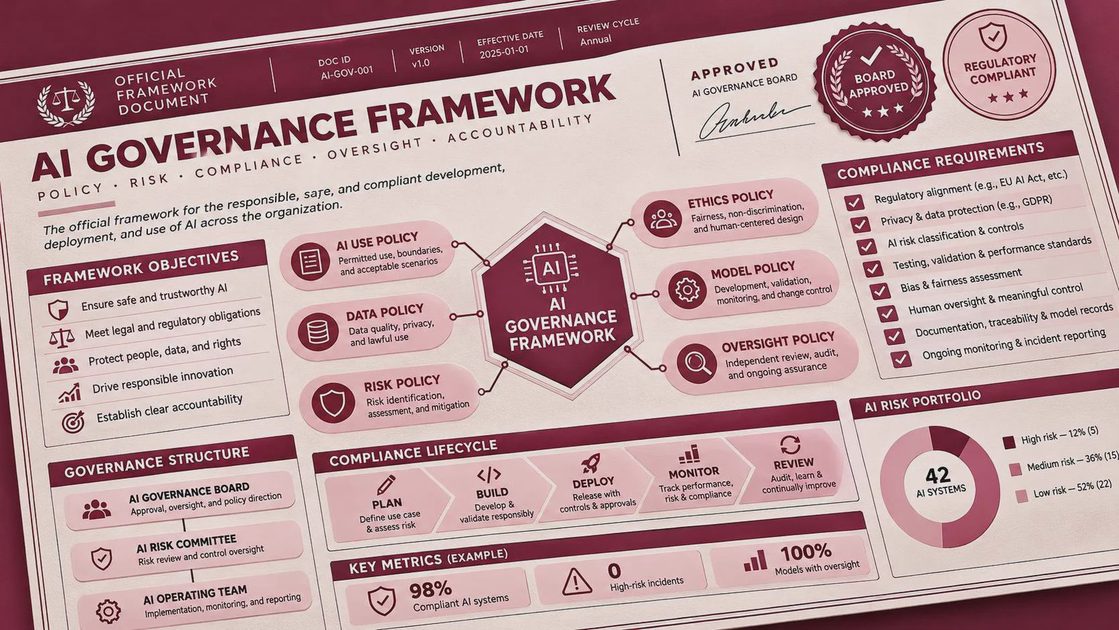
The framework organizes responsible AI around four broad areas. First is internal governance. A company needs clear roles, escalation paths, training, and oversight. A data-science team should not be the only group deciding whether a model is acceptable for customers. Legal, compliance, security, product, and operational leaders may all have a role depending on the use case.
Second is human involvement in AI-augmented decision-making. The framework distinguishes between systems that support a person and systems that operate with little meaningful review. A human reviewer needs enough authority, context, and time to challenge an output. Merely placing a person somewhere in the workflow is not meaningful oversight if that person automatically approves every recommendation.
Third is operations management. Teams should document data sources, model limits, testing results, monitoring plans, incident procedures, and changes made after deployment. Monitoring matters because a model can perform acceptably in a test environment and deteriorate when customer behavior, economic conditions, or input data changes.
Fourth is stakeholder interaction and communication. People should receive understandable information about how AI is used, particularly when an automated recommendation affects access, price, employment, or service. Explainability does not always require publishing source code. It does require giving users a useful account of the factors, process, and appeal route involved.
Why the word “official” causes confusion
Search results often mix the official Singapore framework with consulting checklists, academic commentary, vendor marketing, and newer generative-AI guidance. Those materials can be useful, but they do not carry the same authority. The singapore model ai governance framework official documents come from Singapore's public agencies and describe the framework's intended principles and implementation approach.
That does not mean every page hosted by a government agency is a binding rule. Singapore has used a layered approach: voluntary governance guidance, technical testing tools, sector initiatives, and binding laws where policymakers consider them necessary. Readers should therefore ask two separate questions. What does the framework recommend? What legal requirement applies to this particular system and activity?
The distinction is familiar to anyone who has watched corporate compliance teams turn a helpful guide into a giant spreadsheet. Documentation is valuable only when it reflects real decisions. A beautifully completed risk form cannot compensate for poor data, weak security, or a business process that gives reviewers no realistic ability to intervene.
AI Verify is related, but it is not the framework
Singapore's AI Verify initiative is often mentioned alongside the Model AI Governance Framework. AI Verify is a governance testing framework and toolkit intended to help organizations assess certain AI systems against areas such as transparency, explainability, robustness, and fairness. It supports evidence gathering and testing rather than promising that a model is universally safe.
That difference is important. A test result is a piece of evidence, not a guarantee. The right tests depend on the model, its training data, the deployment environment, and the harms that matter in that context. A system used to rank low-stakes product recommendations should not be assessed exactly like one used to prioritize insurance claims or screen job applicants.
For a U.S. company, AI Verify can be a useful reference for building a repeatable evaluation process. It should not be presented to customers as a blanket international certification unless the organization can clearly explain what was tested, under which conditions, and what was excluded.
What U.S. companies can borrow from Singapore
The most useful lesson from the singapore model ai governance framework official material is operational rather than geopolitical. Start with an inventory of AI systems. Record the model's purpose, owner, users, data sources, affected groups, vendors, known limitations, and business consequences of an error. This immediately reveals which experiments have quietly become production systems.
Next, assign risk-based controls. A marketing copy assistant may need privacy review and fact-checking. A model that influences credit, employment, housing, health care, or insurance decisions needs stronger validation, documentation, human review, monitoring, and appeal procedures. The framework's logic is not that every model deserves identical paperwork. It is that control should match impact.
Finally, create a review loop after launch. Track incidents, complaints, performance drift, overrides, and unexpected outcomes. Set a date for reassessment when the model, data, vendor, or business use changes. These steps align with broader risk-management ideas in the United States, including the NIST AI Risk Management Framework, without requiring a company to pretend that two systems are legally interchangeable.
A sensible reading of the official guidance
Read the singapore model ai governance framework official text as a set of questions for management, not as a magic compliance badge. Who owns this system? What can it do poorly? Who could be harmed? What evidence supports deployment? What happens when a user challenges the result? Which records would an auditor, regulator, customer, or employee need to see?
The framework remains useful because it connects abstract principles to decisions inside an organization. Its limits are equally clear: it is voluntary guidance, it cannot replace applicable law, and it cannot make an unreliable model reliable. The announcement says responsible AI requires governance. The incentives suggest companies also need governance that can survive deadlines, vendor pressure, and uncomfortable findings. That is the real test—and usually the expensive one.
For readers comparing international approaches, the best next step is to consult the current IMDA and PDPC publications, then map their recommendations against the laws and risk standards that apply to your business. Read the announcement. Then read the incentives.




No notes on this sheet yet.