The search phrase gpu rentals -ai is slightly cryptic, which is often how technology markets announce their problems. It could mean someone wants to rent graphics processing units while excluding AI results, or it could be a shorthand query from a buyer comparing general-purpose GPU access with the crowded artificial intelligence marketplace. Either way, the underlying question is straightforward: when does renting compute make more financial sense than buying hardware?
The answer depends on workload, duration, software compatibility, and how much operational inconvenience a team is willing to purchase along with the machine. GPU rentals are not automatically cheaper. They are a way to turn a large capital expense into a variable operating expense, with flexibility as the main benefit and unpredictable demand charges as the main catch.
What gpu rentals -ai might mean in practice
A person searching gpu rentals -ai may be looking for graphics hardware for 3D rendering, video production, scientific simulation, cryptocurrency research, gaming, or software development rather than model training. That distinction matters because the best rental configuration for Blender rendering is not necessarily the best choice for a large language model or a computer vision pipeline.
Rental providers typically offer access through a virtual machine, a dedicated server, or a bare-metal system. A virtual machine is the fastest way to start, but it can introduce shared-network limitations and less control over the underlying environment. Dedicated servers cost more, yet they can provide steadier performance for a production workload. Bare metal is usually the most hands-on option, requiring the customer to manage drivers, storage, security updates, and deployment.
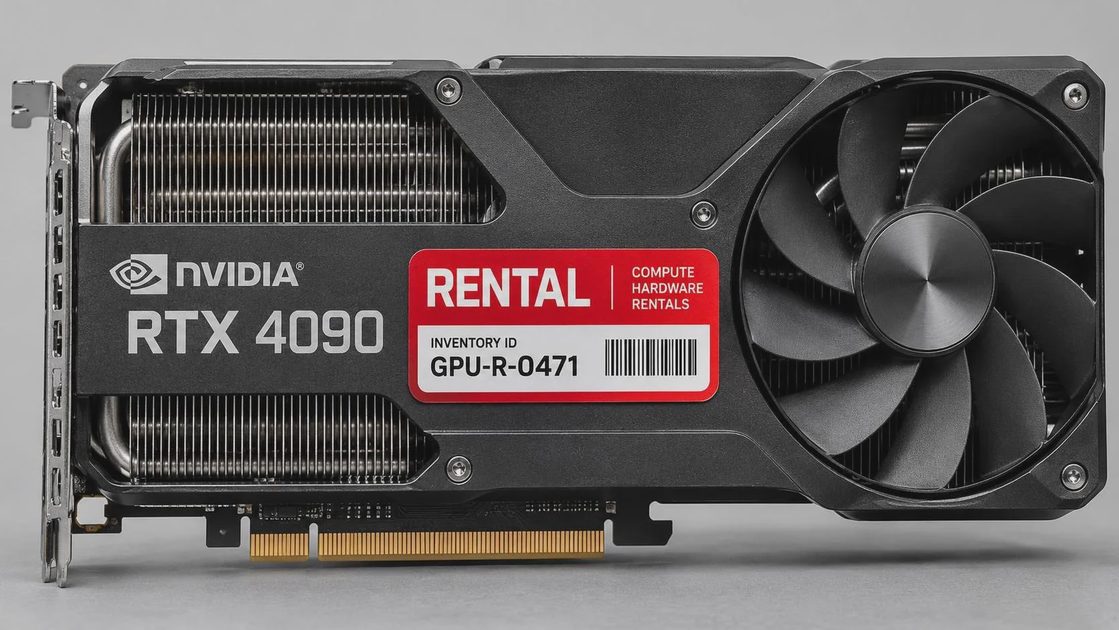
Common hardware names include NVIDIA L4, A10, A100, H100, and newer data-center accelerators, along with consumer cards such as the RTX 4090. These products sit in very different pricing and performance categories. A consumer GPU might be perfectly adequate for rendering or local development, while an enterprise accelerator is designed for memory-intensive workloads and sustained data-center use.
The economics behind renting instead of buying
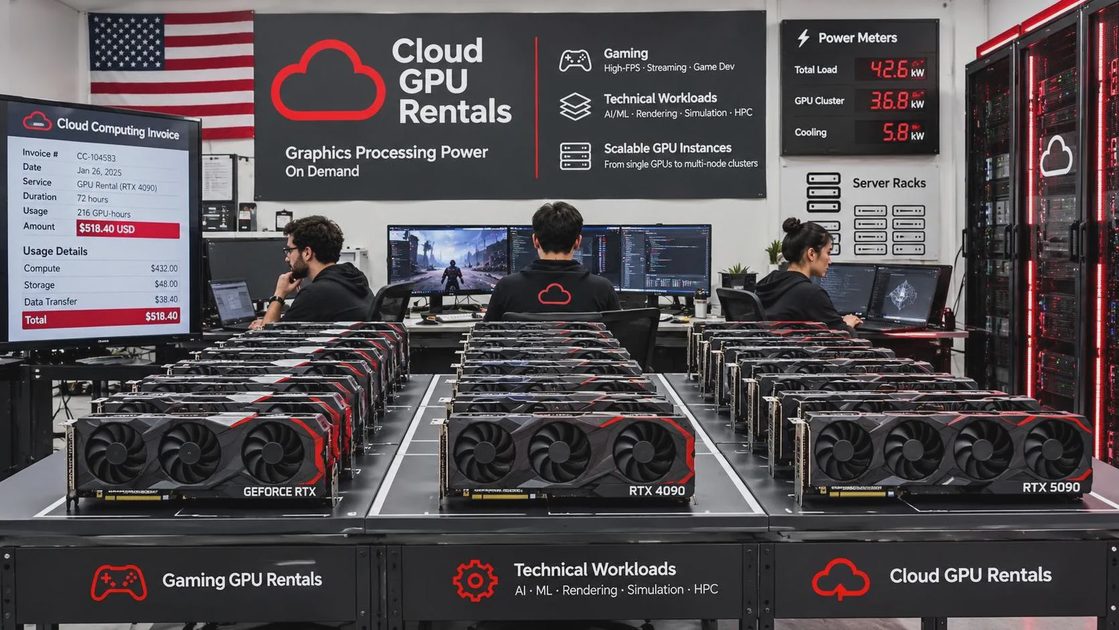
The most useful way to evaluate gpu rentals -ai is to compare the full cost of ownership, not just the hourly rate. Purchasing a high-end workstation can cost several thousand dollars before adding storage, cooling, memory, networking equipment, and maintenance. A data-center server with multiple accelerators can run into tens of thousands of dollars or more. That investment only looks efficient if the hardware stays busy.
Rental rates vary widely by GPU generation, region, reservation length, and provider. A lower-end card might be priced in the range of a few cents to a few dozen cents per hour, while high-end accelerators can cost several dollars per hour or substantially more during tight supply. These are broad planning ranges, not a quote. Storage, data transfer, operating-system licenses, and premium support can add to the invoice.
Consider a small software company that needs one powerful GPU for a six-week prototype. Buying a workstation may create a long-term asset, but it also creates delivery time, maintenance work, and a resale problem if the project changes direction. Renting can make sense when the team values speed and expects uncertain demand. By contrast, a studio rendering every night for two years may find ownership or a committed contract more economical.
The announcement says cloud capacity is abundant. The incentives suggest providers make money when customers reserve capacity, transfer large datasets, and leave machines running. Set budget alerts, automatic shutdowns, and usage caps before launching a job. A forgotten instance can turn a promising experiment into an unpleasant accounting meeting.
How to compare providers without chasing a headline rate
When comparing gpu rentals -ai, start with availability rather than an advertised minimum price. A provider listing an attractive hourly rate is not useful if the required GPU is rarely in stock, located far from the team, or unavailable for the needed operating system. Ask whether the price covers the exact card, the amount of GPU memory, local disk, network bandwidth, and technical support.
The next question is performance consistency. Some platforms use marketplace inventory, where independent operators supply machines. That model can offer low prices, but hardware condition, network quality, and setup standards may differ. A managed cloud provider typically costs more and offers a more familiar support structure. Neither model is universally superior; the right choice depends on whether the team has infrastructure expertise.
Run a short benchmark using the real application. A generic benchmark can flatter a machine that performs poorly with a particular renderer, database, framework, or batch size. Measure startup time, processing time, failure recovery, and data movement. Ten dollars spent on a controlled test is cheaper than committing to a month of unsuitable capacity.
Security, privacy, and contract details
For anyone using gpu rentals -ai for proprietary work, security deserves the same attention as price. Determine where data is stored, who can access the host environment, how disks are erased, and whether the provider offers encryption in transit and at rest. A company handling customer records, medical information, or financial data may face contractual and regulatory requirements that make an anonymous marketplace machine inappropriate.
Read the provider's terms for intellectual property, retained logs, abuse monitoring, and account suspension. Confirm whether snapshots remain after a machine is deleted. Also check the process for retrieving data if an account is closed. A cheap compute instance is not a bargain if extracting several terabytes requires an expensive transfer fee or a support ticket that sits unanswered.
For sensitive workloads, use least-privilege credentials, separate production and test environments, encrypt datasets before upload, and remove temporary files after a job completes. Restrict inbound network access rather than exposing administrative ports to the public internet. These are ordinary security practices, but rental infrastructure can make responsibility unclear. The provider secures the platform; the customer still controls much of the configuration.
A practical buying checklist for a first rental
Before signing up for gpu rentals -ai, write down the workload in operational terms. Record the application, preferred operating system, required GPU memory, expected runtime, dataset size, and maximum budget. Then estimate the cost of an actual project rather than multiplying a promotional hourly rate by a vague number of hours.
Select two or three providers and request comparable configurations. Launch a small test, upload a non-sensitive sample, and record the time required to install drivers and dependencies. Check whether the machine can be paused without losing work. Confirm how billing rounds usage; per-minute billing can be materially different from per-hour billing for short jobs.
Next, set a spending ceiling and an automatic shutdown policy. Ask who receives alerts when usage spikes. If several employees share an account, create separate projects or billing labels so one experiment does not conceal another. At the end of the test, download required outputs, delete snapshots, terminate the instance, and verify that recurring resources are gone.
This process turns a vague technology purchase into a measurable experiment. It also reveals whether the team needs a GPU at all. Some workloads run adequately on a CPU, and some can use a smaller accelerator with more efficient software. Renting the biggest available machine is not a strategy; it is an expensive reflex.
The broader lesson for AI infrastructure buyers
The interest behind gpu rentals -ai reflects a wider shift in computing. Access to hardware is increasingly sold as a service, allowing startups and researchers to begin with limited capital. That expands participation, but it also moves risk into monthly bills, provider dependencies, and capacity shortages. The customer avoids a server room while accepting a relationship with someone else's server room.
For founders, the sensible approach is to rent during discovery, benchmark continuously, and negotiate committed capacity only after usage becomes predictable. Investors should treat infrastructure spending as evidence of demand, not proof of product-market fit. Technology workers should ask whether a proposed GPU deployment improves the product or merely makes a slide deck look more serious.
So what does gpu rentals -ai ultimately tell us? It points to a buyer trying to separate ordinary GPU access from AI hype, or at least trying to make sense of a market where those categories increasingly overlap. Read the announcement. Then read the incentives. A careful test, transparent pricing, and disciplined shutdown policy will usually reveal more than a dramatic claim about unlimited compute.





No notes on this sheet yet.