
AI regulation explained for a lab in San Francisco is not the same document that lands on a 40-person firm in Ohio. U.S. AI policy news often features frontier models, national security, and congressional hearings. Ordinary American businesses meet the same wave as a vendor questionnaire, a cyber-insurance renewal, a state privacy notice, or a customer who suddenly asks whether a chatbot is “in the loop.”
I cover the hearings. I also cover the spillover. The spillover is where most companies actually live. They do not train foundation models. They buy tools, embed widgets, and remain responsible for the output that reaches a customer or an employee. That mismatch—between who writes the rule and who fills out the form—is the story.
The announcement says “AI safety.” The incentives suggest a stack of duties that will be cheaper for firms that already have lawyers, and slower for everyone else.
Ordinary Businesses Are Already in the Blast Radius
You do not need a new federal statute to feel regulatory pressure. Sector rules still apply: hiring, lending, health, education, housing, advertising, and consumer protection. State privacy laws already constrain how data moves into a model. The Federal Trade Commission has said that existing authority over unfair or deceptive practices reaches AI claims. Copyright disputes change what vendors will indemnify. None of that waits for a comprehensive bill.
When I talk to operators who are not in the model business, they describe a quieter sequence. A sales team wants a copilot. Legal asks where the prompts go. IT asks who owns the logs. Insurance asks whether the tool is in production. A customer’s security packet asks for a model card the vendor will not share. That is AI regulation as lived experience.
Where an ordinary firm first feels the rules
Vendor contracts: data-processing terms, training-use toggles, and indemnity caps.
HR and hiring tools: notice, bias testing expectations, and adverse-action processes that already exist in employment law.
Customer chat and ads: claims about what the bot can do, and records of what it did.
Insurance and audits: questionnaires that treat “we use AI” as a control failure unless documented.
State-level statutes: privacy, automated-decision notice, and sector add-ons that do not match the federal talking points.
Read the announcement. Then read the incentives. Congress may be debating definitions. The firm is debating whether to turn the tool off until someone owns it.
What Proposed Duties Would Actually Require
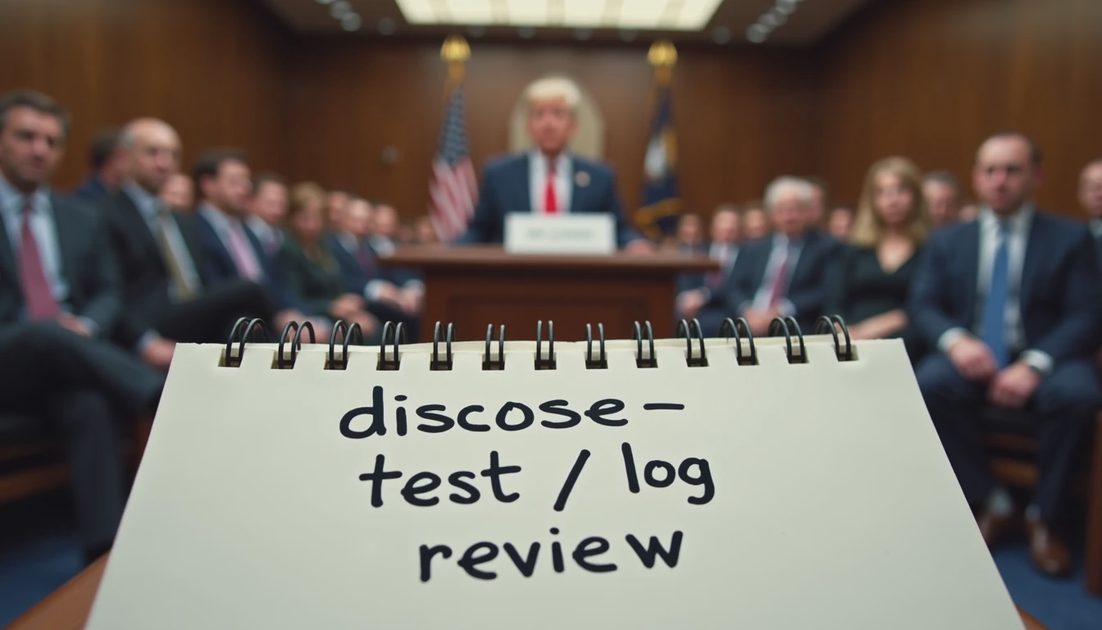
Policy language loves nouns: safety, transparency, accountability. Operative text loves verbs: disclose, test, log, allow opt-out, keep a person in the decision, or refrain from a use. Ordinary businesses should read the verbs. The verbs determine staffing.
A notice duty can be a sentence on a website. An evaluation duty can be a consulting invoice. A recordkeeping duty can be a storage architecture. A human-review duty can be a new headcount. A restriction can kill a product line. These are not equivalent, and they do not fall evenly.
A practical map from slogan to staffing
If the rule emphasizes… | An ordinary business may need to… | Who inside the firm feels it |
|---|---|---|
Disclosure | Label automated interactions and keep the label accurate | Marketing and legal |
Vendor management | Inventory tools, subprocessors, and training-use settings | IT and procurement |
Evaluation | Test a hiring or credit tool against a documented method | HR, compliance, outside counsel |
Logging | Retain prompts, outputs, and versions for a defined period | IT and records |
Human review | Assign a named reviewer before specified decisions | Operations |
Use restriction | Stop a feature (e.g., scraping or certain biometric uses) | Product and sales |
I keep this table in the same notebook I take to hearings. The hearing is about principle. The table is about payroll.
What I Tell Readers Who Are Not Trying to Lobby
Most American firms will not hire a dedicated “AI policy” shop. They need a smaller protocol that still respects the law that already exists.
A five-step protocol that does not require a new department
Inventory: List every tool that generates or scores content that can reach a customer, an employee, or a regulated decision. Include the free ones.
Classify: Separate toys (summarize a public blog) from high-stakes uses (hire, fire, lend, diagnose, police, housing).
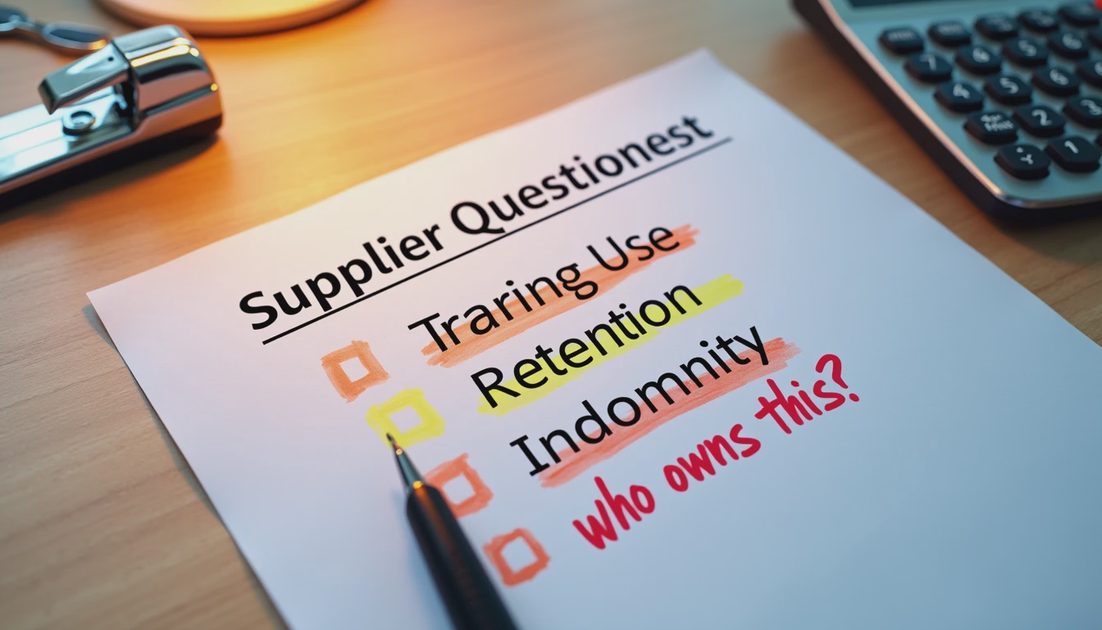
Contract: For high-stakes uses, get written answers on training-use, retention, subprocessors, and indemnity. If the vendor will not answer, that is an answer.
Record: Keep version, date, and a sample of outputs for the uses you would have to explain.
Own: Put a person’s name next to each high-stakes use. “The model” is not an owner.
This protocol is not legal advice. It is reporting, compressed into a checklist, from conversations with policy staffers, product managers, and operators who have already been through a customer audit. Elena Whitfield will not pretend a newsletter replaces counsel. Waiting for a comprehensive federal bill is not a plan.
What Changed, and What Did Not
What changed is the density of tools. What did not change is that American businesses were already regulated in their actual domains. AI did not invent employment law, consumer protection, or privacy. It added a fluent, hard-to-audit component in the middle of processes that still have to be explained to a human.
Coverage that treats “AI regulation” as a single object will keep missing the firms that never appear at the hearing. Coverage that follows the verbs—disclose, test, log, review, refrain—will be useful in Cleveland and in Brooklyn.
Here is what the announcement often implies, and what the incentives reward. The announcement implies that the frontier lab is the regulated party. The incentives, in many drafts, spread duties to deployers because that is where harm becomes a case. Ordinary businesses are deployers. They should read like deployers, not like spectators.
Who really benefits, and who really pays? In this beat, the benefit of a vague rule is flexibility for large vendors. The cost of a vague rule is a questionnaire that a small legal team cannot close. That is the policy story I will keep writing.
No notes on this sheet yet.