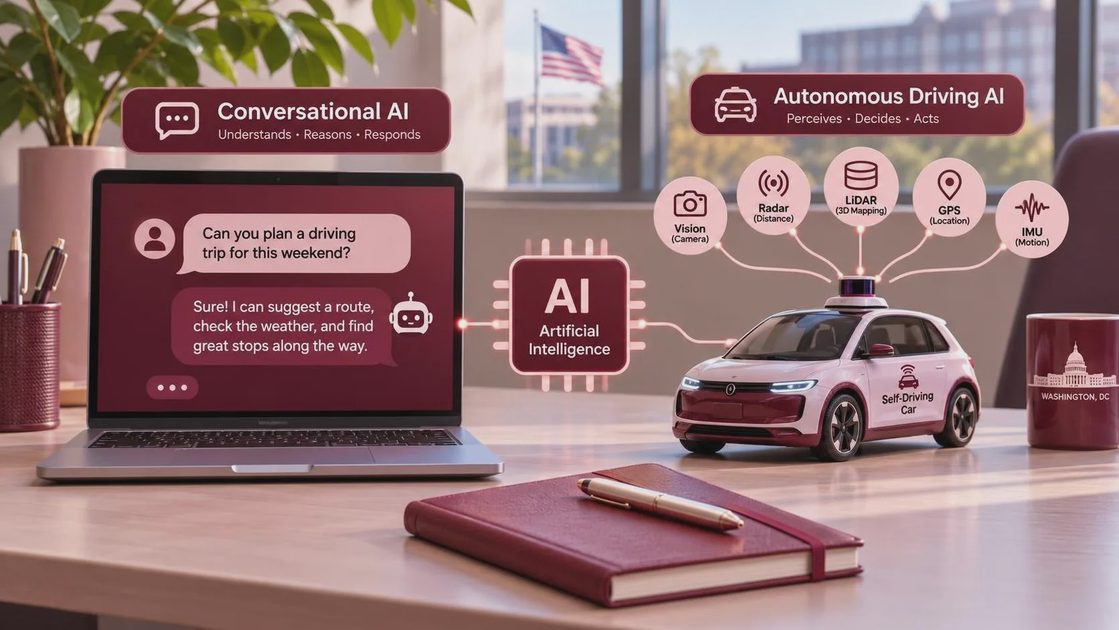
People asking how does chatgpt differ from waymo ai are usually comparing two products that both arrive under the oversized label of artificial intelligence. That label is technically correct and practically unhelpful. ChatGPT is primarily a conversational generative AI system. Waymo AI is part of an autonomous-driving system designed to perceive roads, predict behavior, and control vehicles. One produces language and other media; the other makes time-sensitive driving decisions in the physical world.
The distinction matters because impressive conversation is not the same as reliable action. ChatGPT can explain a traffic rule, draft a route plan, or discuss self-driving technology. It does not, simply by answering a prompt, operate a car. Waymo's system has a different job, a different set of sensors, a different safety case, and a much narrower operating environment.
ChatGPT is built to generate responses
ChatGPT, developed by OpenAI, is based on large language model technology. It processes an input, uses patterns learned during training and information available through its product tools, and generates a response. Depending on the version and configuration, it can work with text, images, files, audio, and software code. Its strength is flexible communication: summarizing a report, brainstorming a campaign, explaining a technical concept, or turning rough notes into a polished email.
That flexibility is also the source of its famous weakness. A language model can produce an answer that sounds confident while containing an error. It does not possess a human driver's continuous physical awareness of a street, and a fluent explanation is not evidence that its underlying claim is correct. ChatGPT is useful as an interface for information and tasks, but users remain responsible for checking important outputs.
Its commercial incentives reflect that role. OpenAI can sell subscriptions, enterprise access, and developer usage through software interfaces. The product can serve millions of users without placing a sensor suite on every vehicle. Scale comes largely through computing infrastructure, distribution, and model improvements.

Waymo AI is built for an autonomous vehicle
Waymo's system is designed for a car moving through a real environment. It combines cameras, lidar, radar, high-definition mapping, positioning technology, onboard computing, and machine-learning software. The system must identify vehicles, cyclists, pedestrians, road markings, signals, construction zones, and unusual events, then predict how those elements may move.
Waymo operates a commercial autonomous ride service in selected areas, commonly associated with the Waymo One service. The important phrase is selected areas. Autonomous driving is not one universal capability that works equally well on every road, in every weather condition, and under every local rule. Service boundaries, mapped locations, vehicle hardware, remote assistance procedures, and safety policies all matter.
A useful answer to how does chatgpt differ from waymo ai is that Waymo's software is connected to an action loop. It senses, interprets, plans, and controls steering, braking, and acceleration. ChatGPT generally responds to a request. Waymo must respond to a changing world in fractions of a second, where a bad decision can cause physical harm.
The systems handle uncertainty differently
Both systems face uncertainty, but they manage it in different ways. ChatGPT can acknowledge uncertainty, ask a clarifying question, or revise an answer after a user supplies more context. Those behaviors are useful, although they do not guarantee truth. A user can often pause before acting on the response.
A vehicle cannot pause in the middle of an intersection to compose a thoughtful paragraph. Waymo's system must estimate distances, track moving objects, select a safe path, and obey traffic controls continuously. It can slow down, stop, wait, or request assistance when a situation falls outside its expected conditions. Its safety strategy therefore includes redundancy, testing, operational limits, and hardware designed for perception.
This is why comparing the products by asking which AI is smarter misses the point. Intelligence in a chatbot often looks like breadth and fluency. Intelligence in a driving system looks more like dependable perception, conservative planning, and repeatable behavior under pressure. Neither definition settles every debate about performance, but they describe different engineering problems.
How does chatgpt differ from waymo ai in business terms?
The economics are also far apart. ChatGPT is software delivered through an app or an API. Its major costs include model training, data-center capacity, engineering, safety work, and customer support. Revenue can come from individual subscriptions and organizations that pay for higher limits, administrative controls, or programmatic access.
Waymo faces software costs too, but it must also fund vehicles, maintenance, charging or fueling, insurance, mapping, safety operations, regulatory work, and fleet logistics. A rider's fare must support much more than a server request. Vehicle utilization matters: an autonomous fleet has to spend enough time carrying passengers to justify expensive equipment and operations.
The incentives suggest different paths to market. ChatGPT can expand into new countries or workplace functions through software distribution, subject to local rules and infrastructure. Waymo must validate each service area and convince riders, regulators, cities, and commercial partners that its operations are acceptable. A flashy product demonstration is easier to stage than a reliable service operating every day.
What each system can and cannot do
ChatGPT can help a transportation company draft customer notices, analyze trip data supplied by a user, write code, or explain why lidar and radar are different. It can also act as a conversational layer around other software. That does not mean the model itself has authenticated access to a vehicle or is making the vehicle's driving decisions.
Waymo AI can support perception and driving functions within the system for which it was designed. It is not a general-purpose office assistant, research chatbot, or substitute for a language model. A rider cannot reasonably ask the vehicle to write a legal memo, and a business cannot treat a ride service as an all-purpose AI platform.
The boundary is important for safety and accountability. If ChatGPT gives a poor summary, the damage may be wasted time or a bad decision. If an autonomous system misjudges a moving object, the consequences can be physical. That difference demands distinct testing standards, oversight, reporting, and user expectations.
How to evaluate the comparison without the hype
When someone asks how does chatgpt differ from waymo ai, start with the task rather than the marketing. Ask what the system receives as input, what action it is authorized to take, how it handles uncertainty, and what happens when conditions fall outside its design. Then ask who bears the cost when it fails.
For ChatGPT, examine factual reliability, privacy controls, data handling, security, and whether a human reviews consequential work. For Waymo, examine service geography, weather and road limitations, incident reporting, vehicle supervision, accessibility, and the regulatory framework in the area where it operates. Company claims are useful, but they are not the same as independent evidence.
The cleanest conclusion is simple: ChatGPT is a general conversational and generative AI product, while Waymo AI is a specialized autonomous-driving technology stack. They may share machine-learning techniques, but they do not share the same job. Read the announcement. Then read the incentives. That is usually where the real comparison begins.





No notes on this sheet yet.