
AI benchmark results explained in a keynote usually travel as a single number. The number is precise. The task mix, the contamination risk, the prompting method, and the human baseline are not. I have watched readers treat a two-point gain on a public suite as if it were a warranty. It is not. It is a measurement on a test the vendor (or a community) chose to run.
This piece is a user’s guide to what those scores can support and what they cannot. AI model comparison that begins and ends with a leaderboard is how otherwise careful people get overconfident.
What a Benchmark Is For
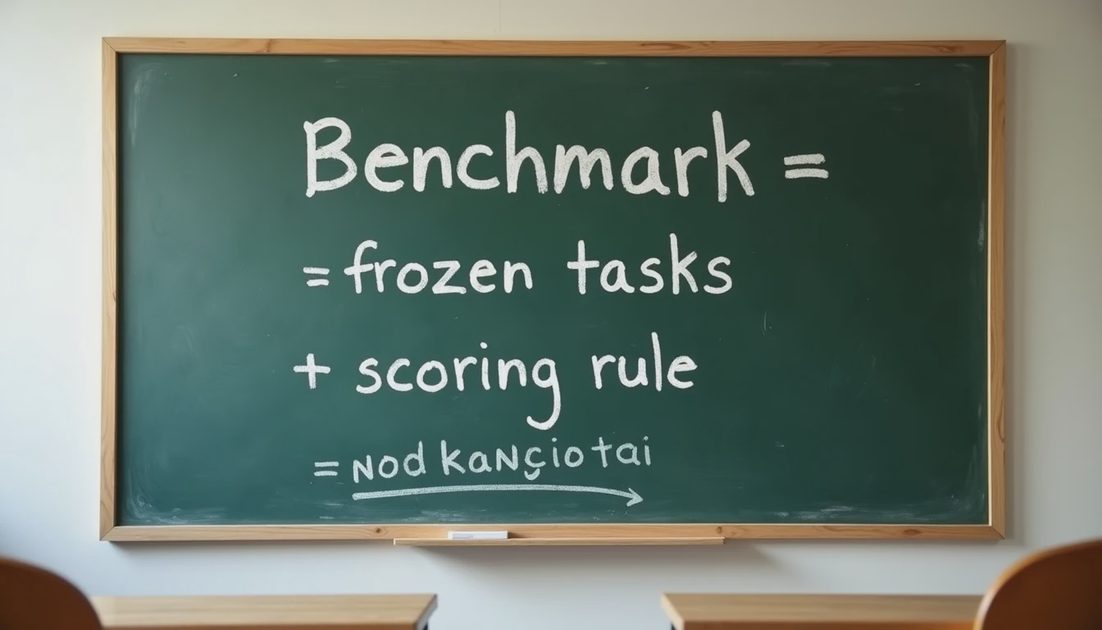
A benchmark is a frozen task set plus a scoring rule. When they are used carefully, public suites let labs and outsiders talk about the same tasks instead of dueling anecdotes. They can catch regressions. They can show that a model that was weak at math or code moved, or did not. They can make it harder to hide a collapse behind a fluent demo.
That is already valuable. It is also limited. A frozen task set is not your ticket queue. A scoring rule is not your liability policy. A public leaderboard is not a substitute for an evaluation on your documents, with your tools, under your latency and cost constraints.
What scores can reasonably support
Relative movement on the same protocol over time
A claim that a model is no longer incompetent on a named skill (if the skill is actually in the set)
A reason to run a deeper, domain-specific eval
A check that a “new” model is not simply a rename of an old one
Read the announcement. Then read the incentives. The incentive is to pick the suite that moved.
What the Number Quietly Leaves Out
Contamination is the obvious problem: if exam questions leaked into training data, the score is partly memorization. Prompting is the less obvious one: a few-shot template, a chain-of-thought instruction, or a tool loop can change results without any change in the base model. Sampling and retries can do the same. So can hiding the cases the model refuses.
Then there is construct validity. Multiple-choice academic tests do not measure whether a system can keep a customer’s permissions straight. Coding puzzles do not measure whether an agent will delete a repo. “Human preference” in a chat arena measures what raters like in a short exchange, not what a nurse, a loan officer, or a paralegal can trust.
A compact map of mismatch
If the score is from… | It may tell you… | It probably does not tell you… |
|---|---|---|
Academic QA suites | Exam-style recall and reasoning on those items | Performance on your internal corpus |
Code tests | Ability to pass hidden unit tests of a certain style | Maintainability, security, or review time |
Chat arenas | Short-session preference | Long-horizon task completion |
Vendor internal evals | What the vendor optimized and reported | What was not reported |
Safety red-team scores | Behavior under those attacks | Behavior under your employees’ actual prompts |
AI benchmark results explained without this table become a sport. Sports are fine. Procurement is not a sport.

How I Read a Score in Practice
I ask five questions before I let a number into a sentence that a reader might act on.
Five questions for any new score
Protocol: Is the evaluation code, prompt, and scoring public enough to repeat?
Contamination: Has anyone checked overlap with training or evaluation leakage?
Baseline: Are we comparing against the prior model, against a human, or against a rival on a different protocol?
Variance: Is this one run or a distribution? A single run of a stochastic system is a press release.
Transfer: What independent evidence exists that the skill transfers to messy, permissioned, tool-using work?
If those answers are thin, I will still report that the vendor published a number. I will not promote the number into a conclusion about workplace value. Enterprise AI trends that skip this step produce dashboards nobody should manage a budget with.
I keep printed eval tables in a folder next to old newspaper clippings. The clippings remind me that precise figures have always been a way to end an argument early. The folder reminds me to start one.
A Better Use of Public Scores
Use public benchmarks as a filter, not as a trophy. If a system cannot handle a well-known public task that resembles your need, you may not need a custom eval to walk away. If it can, you now have permission to spend the money and time on a private eval: your documents, your tools, your failure costs.
Here is what changed, and what did not. The public evaluation ecosystem got broader—arenas, specialist suites, and more system cards. The temptation to treat a leaderboard as a product review did not fade. This is meaningful scientific infrastructure. It is not yet a measurement of whether the workflow works.
Who really benefits, and who really pays? Labs that can afford eval engineers benefit from the appearance of comparability. Buyers pay if they outsource judgment to a number that was never about their distribution. Keep the number. Add the caveats. Then go look at the work.


No notes on this sheet yet.