
AI product reviews for businesses often lead with a stopwatch. A task that took twenty minutes now takes two. The slide is tidy. The oversight is not on the slide. I have watched this pattern in enterprise AI trends for years: vendors measure generation, buyers live with review, and the gap between those two clocks is treated as a rounding error.
Time saved is a real possibility. It is not a default. A tool can draft faster and still add hours if someone has to check citations, permissions, tone, and downstream systems. AI adoption statistics that count only the draft step will always look kinder than the workflow that actually ships.
The announcement says “minutes, not hours.” The incentives suggest that the minutes belong to the model and the hours still belong to a person with a job title.
Generation Is Not the Same as Completion
Completion is the moment a task can leave the building: a ticket closed, a contract sent, a report filed, a customer answered without a cleanup crew. Generation is the moment a fluent draft appears. Most demos measure generation. Most jobs measure completion.
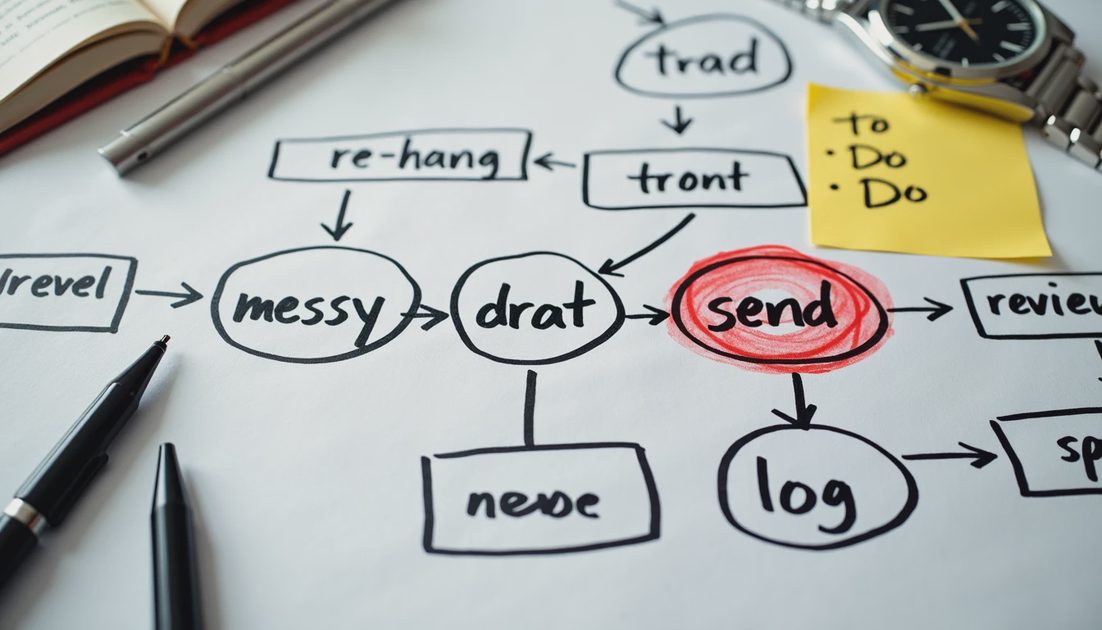
When I test a tool, I start the clock at the messy input and stop it when a responsible adult would hit send. That interval includes retrieval, prompting, waiting, reading, correcting, logging, and handing off. It is less cinematic. It is closer to payroll.
The hidden work that turns a fast draft into a slow day
Fact-checking names, numbers, and citations the model invented or blended.
Permission checks: did the prompt include data the tool is not allowed to store?
Style and policy alignment with the company’s actual voice, not the model’s average voice.
Integration work: copying output into the system of record by hand because the connector is “coming soon.”
Exception handling when the model is confidently wrong on the one field that matters.
If you skip those items, you can publish a cheerful time-saved claim. If you include them, you get AI product reviews for businesses that a practitioner can use.
Read the announcement. Then read the incentives.
How Oversight Changes the Math
Oversight is not a moral add-on. It is a cost. It has a skill requirement, a delay, and a failure mode. A junior employee who must review every paragraph may be slower than if they had written the paragraph. A senior employee who reviews at high speed may be expensive per hour. Neither fact appears in a demo reel.
I do not argue that humans should inspect every token forever. I argue that the inspection load should be named, measured, and owned. “Human in the loop” is a phrase that can mean a lawyer reading every clause or a checkbox nobody clicks. Those are not the same product.
A simple way to recast a time-saved claim
Vendor claim | What to add before you believe it | What you might learn |
|---|---|---|
Drafts 10x faster | Time to a sendable draft, including review | Speed only in the middle of the pipeline |
Reduces tickets | Tickets reopened, escalated, or duplicated | Volume down, severity up |
Frees experts | Where expert hours actually went | Experts now audit the model |
Cuts writing time | End-to-end cycle time for the document type | Writing fell, QA rose |
Pays for itself | Oversight labor, error cost, and tool spend | Savings depend on error rate |
The table is a filter, not a ranking. I do not rank tools. I refuse to treat a partial clock as a full clock.

A Field Test I Use After the Demo
After a briefing, I ask a practitioner—not the vendor—to run one real task. Not a canned PDF. Not a clean CRM record. One live object from last week, with the messy fields left in. Then I ask three questions.
Three questions that keep the stopwatch honest
Where did the person still have to intervene, and how long did that take?
What would happen if they skipped that intervention once a day for a month?
Who is accountable if the skipped step reaches a customer, a regulator, or a court?
If the answers are “we are still figuring that out,” you do not yet have a time-saved story. You have a pilot. Pilots are allowed. They should not be billed as production economics.
I have used this test in conversations with product managers and former industry employees who will talk after the cameras are off. The pattern is stable: tools that constrain the action space (a form, a ticket template, a code patch with tests) tend to survive contact with oversight. Tools that emit unbounded prose tend to create a second job called “reader of the machine.”
What Changed, and What Did Not
Model fluency improved. That is real. Many teams now get a usable first draft on tasks that used to start from a blank page. That is also real. What did not change is the economics of responsibility. Someone still has to sign. Someone still has to clean up. Someone still has to explain the error to a person who does not care that the demo worked.
Elena Whitfield will keep writing AI product reviews for businesses in this narrower sense: not a score, not a podium, a map of generation versus completion. If a vendor publishes a method for measuring review time, error rate, and rework, I will treat that as news. If a vendor publishes only a stopwatch on the draft, I will treat that as a claim.
Can an AI tool save time after you count the oversight? Sometimes. On bounded tasks, with logs, with a person who knows what “good” looks like, and with a costed plan for when the model is wrong. That sentence is less exciting than a keynote. It is closer to how work actually moves through an American office.
Here is what the announcement usually omits, and what the incentives reward. The announcement omits the reader of the machine. The incentives reward a number that fits on one slide. Your notebook does not have to follow.
No notes on this sheet yet.